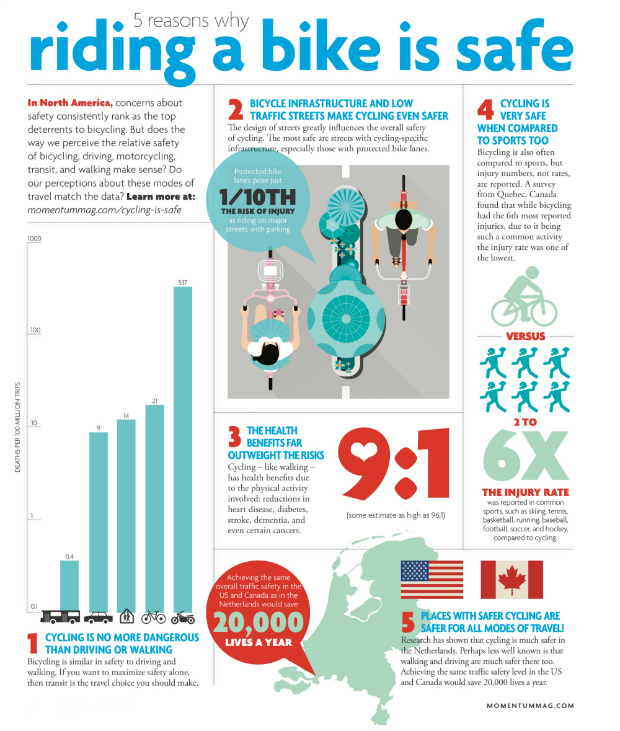
Importance of cycling safety
Cycling safety is important, first because of the injuries themselves. In addition, perceived risks discourage people from cycling, despite consistent evidence that any risks are greatly outweighed by individual and population health benefits:
- increases in physical fitness, declines in body weight;
- lower risks of associated diseases, e.g., diabetes, stroke, heart disease, cancer, and osteoporosis;
- reductions in air, noise, and water pollution.
Comparing injury risks
Data on fatality rates (figure below) from British Columbia (note: no data for bus passengers or motorcyclists) and the United States indicate that the safest mode of daily travel, by far, is bus transit, and the riskiest, by far, is motorcycling. Driving, walking and cycling are intermediate between these. Two modes of transportation, walking and cycling, have countervailing health benefits because they involve physical activity.
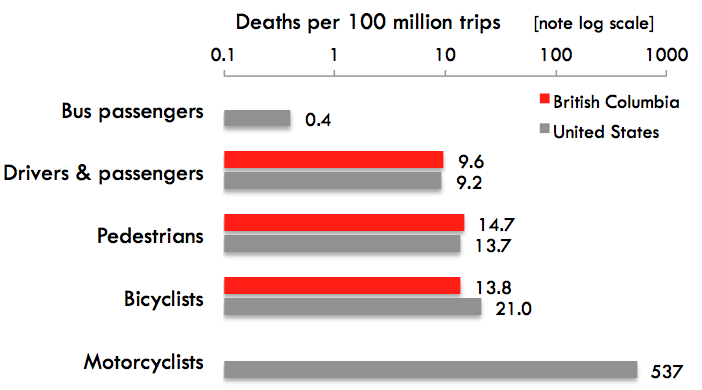
Another way to think about risk is to calculate the number of trips to incur a single fatality. Our BC data show that 1 car driver or passenger died per 10,417,000 person-trips, 1 pedestrian died per 6,803,000 person-trips and 1 bicyclist died per 7,246,000 person-trips. Using the US data for the other two travel modes, 1 bus passenger died per 250,000,000 person-trips and 1 motorcyclist died per 186,000 person-trips.
Broader international comparisons indicate that cycling in Europe is safer than in North America. For example, in the Netherlands, cycling fatality rates are about one-third of those in North America. This difference in risk and the concerns about cycling safety that many people express led us to study factors that might reduce injury risks.
Cycling injury risk factors
If cycling is safer in Europe than in Canada, it can be made safer here. To increase cycling safety, the first step is to understand the determinants of injury risk. One of the factors that differs between European countries with low cycling injury rates and North America where rates are higher is the transportation infrastructure for cycling.
Commuter cycling infrastructure in Canada and the United States tends to place cyclists on road, often beside both moving and parked motor vehicles. In contrast, northern European cities offer more dedicated cycling infrastructure alongside roads, but separated from motorized traffic. The relative merits of these two styles of infrastructure from a safety perspective are the subject of a great deal of debate. As an example, a California transportation engineer, John Forester, has advocated cycling on roads in vehicle lanes with cars as the safest mode of travel (“vehicular cycling”). For many years, his thinking was integrated into North American transportation planning.
The proportion of trips by bicycle is another factor that differs between European countries and North America. In the US and Canada, cycling represents 1 – 2% of urban transportation trips. In Austria, Denmark, Germany, Finland, Sweden, Switzerland and the Netherlands 10 – 30% of urban trips are made by bicycle. Studies consistently support the principle of safety in numbers: death rates and injury rates are lower where cycling modal shares are higher.
Our research on injuries
Because of the importance of injuries to well-being and to choice of cycling as a mode of transportation, our program of research has addressed injuries in a number of ways:
- We reviewed the literature related to the types of route infrastructure and the likelihood of injuries, as well as the literature on the risks and benefits of cycling and walking.
- We designed and conducted an innovative study in Vancouver and Toronto, Bicyclists’ Injuries and the Cycling Environment or the “BICE” Study. It examined which route types are associated with higher and lower cycling injury rates.
- We compared the results of our study and an updated review of the injury and conflict literature to cycling training materials from drivers licensing agencies in each Canadian province and those of non-governmental cycling training organizations. The goal is to help ensure that training materials are evidence-based.
- We compared injury and fatality rates of different modes of transportation, to put cycling injuries in context of other modes and to allow comparisons of traffic injury rates between countries.
- We compared cycling injury hospitalization rates across Canadian provinces with different cycling mode shares and different helmet laws.